Online booking and appointment system: how it stops costing you customers in Málaga
I am Elmar Mamedova, full stack developer in Málaga, and there is one conversation that comes up in almost every meeting with owners of service businesses: "Elmar, the thing is I never stop picking up the phone to give appointments". Hairdressers, clinics, restaurants, consultancies… the pattern is always the same. Someone stops doing their job to jot down a booking in a notebook, and meanwhile two other calls ring out and are lost. Those missed calls are customers who go to the competition.
In this article I am going to explain, without jargon, how much managing appointments by hand really costs you, what a good online booking system does for you and how it is implemented in a real business. It is not a tool for big chains: today any freelancer or small business can have their calendar working 24/7 for far less than they lose each month in empty slots. Let"s get to the point.
How much managing appointments by phone really costs you
The phone seems free, but it is not. Every time someone on your team picks it up to give an appointment, they stop attending to the person in front of them, cutting hair or reviewing a file. If you do the maths, a reception desk that handles bookings easily spends between one and two hours a day just coordinating the schedule: confirming, moving, cancelling and reminding. Multiply that by the days you open each month and you will see that the hidden cost is far higher than any tool.
And then there is what you do not see. The customer who calls at 10 pm when they are free and, because nobody answers, books somewhere else. The appointment jotted down wrong that causes an awkward overlap. The slot left empty because someone did not say they were not coming. Each of those small failures has a price, and added together they explain why many businesses work a lot and bill less than they could.
In short, managing appointments by hand costs you on three main fronts:
- Missed calls: the business only "exists" during opening hours, precisely when the customer is busiest.
- Human error: double bookings, appointments written down wrong and incomplete contact details.
- Team time: hours of qualified staff spent on a task a system does on its own.
A figure to think about
A business that loses just 3 bookings a week by not answering the phone outside hours could be letting more than 150 appointments a year slip away. Even if each one is worth little, the cumulative total more than pays for an online booking system over several years.
The real advantages of an online booking system
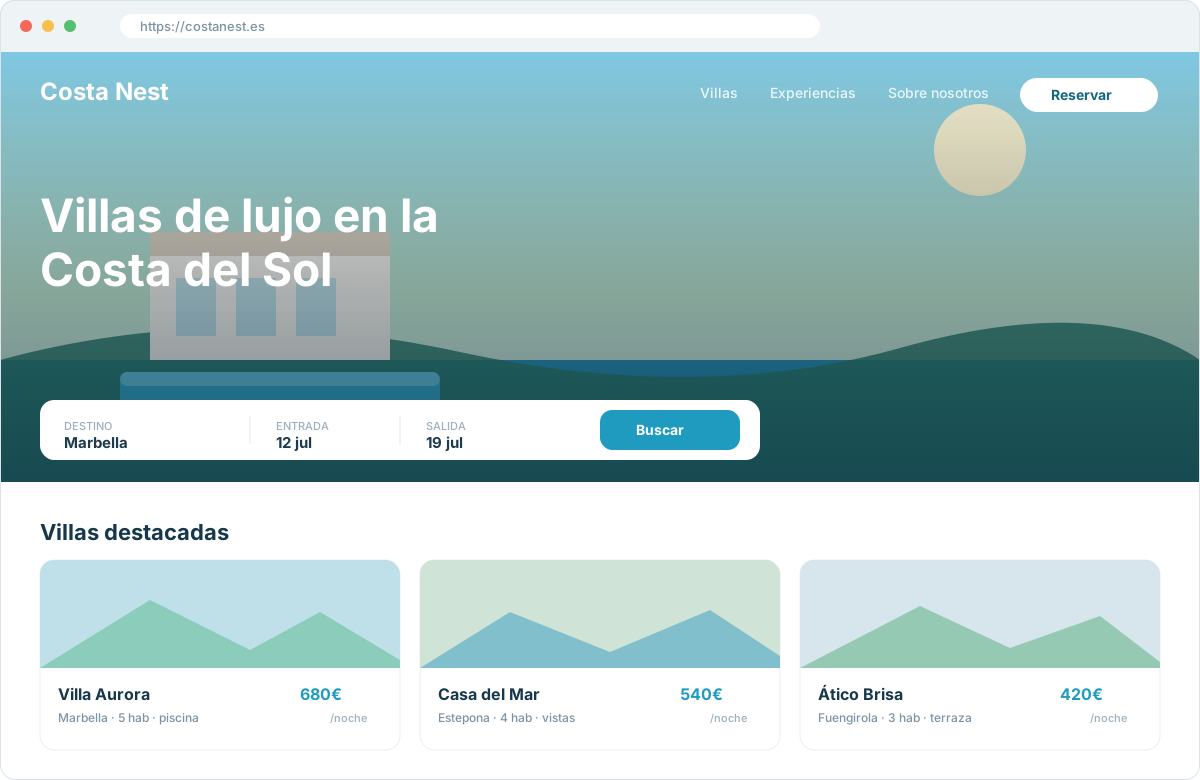
An online booking system is not "putting a button on the website". It is moving the whole process of requesting an appointment into an automatic flow that runs without anyone having to step in. The customer arrives, sees the real free slots, chooses, leaves their details and receives confirmation instantly. Your schedule updates on its own and all you have to do is get ready to serve.
The first advantage, and the most obvious, is availability. Your business starts taking bookings 24 hours a day, 7 days a week. It does not matter whether the customer wants to book on a Sunday night or at six in the morning: the system is there, it never gets tired and the line is never busy. For many sectors, a significant share of bookings happen precisely outside opening hours, so it is exactly the moment when you used to lose those opportunities.
The second big advantage is the reduction of no-shows, those appointments that get booked and that nobody turns up to. With automatic reminders by WhatsApp or email a day before, the customer confirms or cancels in time, and that slot becomes available again for someone else. It is one of the most direct returns: fewer absences means more of your schedule put to use with the same effort. I develop this logic of getting repetitive tasks off your plate in depth in my article on automating business tasks.
The third advantage is quiet but powerful: the data. Every booking feeds your customer base with name, phone, email, visit history and preferences. That information, well connected to a CRM, lets you know who your regular customer is, win back those who have not been in for a while and send campaigns that make sense. If you want to understand why this matters so much, I explain it in what a CRM is and in the definition of customer relationship management.
What a good booking system must have
Not all booking systems serve the same purpose. There are generic solutions that force you to adapt your business to the tool, and there are custom systems that adapt to how you work. Before choosing, it is worth being clear about which features make the difference between an online calendar that helps and one that causes more problems than it solves.
These are, in my experience, the essential elements:
- Real-time availability: the customer only sees slots that are genuinely free, with no risk of double bookings.
- Automatic reminders by WhatsApp and email to reduce absences.
- Management of services and durations: a 30-minute haircut is not the same as a two-hour treatment.
- Booking with several professionals or resources (chairs, rooms, tables) depending on the sector.
- Cancellation and rescheduling by the customer, without having to call.
- Online payment or deposit when you want to filter out non-serious bookings.
- Connection with your calendar and your customer base so everything is recorded.
A special mention for online payment. In sectors with lots of no-shows, asking for a small deposit at the moment of booking drastically reduces absences, because the customer genuinely commits. With a payment integration like Stripe you can charge that deposit securely and deduct it from the final service. It is not always necessary, but when a business suffers many absences, it is the most effective solution.
My recommendation
Do not choose the system with the most features, choose the one your team will actually use. A simple online calendar well connected to your day-to-day performs far better than a huge platform nobody understands. What matters is that booking is easy for the customer and comfortable for you.
The sectors that benefit most in Málaga
Any business that runs on appointments or bookings benefits, but there are sectors where the change is especially noticeable because they live off the schedule. In Málaga and the Costa del Sol I often work with these profiles, and the impact is usually immediate.
- 1Clinics and practices (dental, physiotherapy, aesthetics, psychology): many appointments, critical reminders and the need to avoid absences that leave expensive gaps.
- 2Hairdressers and beauty salons: constant bookings, several professionals and services of different durations that the system handles on its own.
- 3Restaurants: table bookings that free staff from the phone at peak time, with capacity and shift control.
- 4Consultancies and firms: appointments with a specific consultant, calendar integration and automatic customer records for later follow-up.
The common denominator is clear: these are businesses where every slot in the schedule has a high value and where a missed call can mean losing a customer forever. If you want to see how I apply this in real projects, you have several examples in my project portfolio.
The best calendar is not the one with the most features, but the one that works for you while you attend to the person in front of you. When booking is easy, the customer books more.
Does your business still depend on the phone?
I help you set up a booking system that works for you around the clock and stops costing you customers. Tell me how you manage your appointments today and I will propose a solution tailored to you.
See automation solutionsIntegration with the calendar and with WhatsApp or email
A booking system that lives in isolation is not much use. Its real value appears when it connects with the tools you already use every day. The first and most important is your calendar: every booking must appear automatically in your Google Calendar or in each professional"s schedule, so there are never overlaps and the whole team sees the same thing in real time.
The second key integration is the notifications. The customer receives confirmation on booking and a reminder before the appointment, ideally by WhatsApp, which is where people actually read messages. Email is left as a backup and for sending more detailed information. Set up well, this flow almost completely eliminates the "which day was my appointment?" calls and reduces absences without anyone having to lift a finger.
The third connection, the one that makes the system most profitable in the medium term, is the one that links bookings with your customer base. Every recorded appointment builds a history: who comes, how often, which services they book. With that data in a CRM you can win back inactive customers, reward regulars and truly understand your business. Google also values a well-structured, fast website for ranking, as reflected in Google"s own search documentation, so integrating bookings into your website pays off twice over.
How it is implemented in your business, step by step
The idea of changing the way you manage appointments scares more than a few people, but the process is far simpler than it seems. It is not about revolutionising your business overnight, but about gradually moving the schedule to a system that runs it for you. This is how I usually approach the implementation with my clients in Málaga:
- 1We analyse how you manage appointments today: services, durations, professionals and the problems that hurt you most.
- 2We configure the system with your real slots, your cancellation rules and, where appropriate, the online payment deposit.
- 3We integrate bookings with your calendar and with reminders by WhatsApp and email.
- 4We connect everything with your customer base or CRM so every booking is recorded.
- 5We link it to your website and your Google listing so the customer can book from wherever they find you.
- 6We train your team and fine-tune during the first weeks with real data in hand.
In most cases, within a few weeks the business is already taking online bookings without friction. And the best part is that the system can be expanded over time: we start with the essentials and keep adding automations as you see results. If you want to go deeper into how to chain these processes together so the business runs almost by itself, I explain it in my automation guide.
Start with what hurts most
You do not have to automate everything on day one. Identify the biggest pain point (missed calls, no-shows or reception time) and start there. The first tangible result is what convinces the whole team to keep moving forward.
Conclusion: your schedule can work on its own
Managing appointments by phone was normal for years, but today it is a competitive disadvantage. While you answer calls during opening hours, your customers want to book when it suits them, receive a reminder and not have to call to change a time. An online booking system covers exactly that, and along the way gives you back time, reduces errors and organises your business information.
The question is not whether your business in Málaga needs an online calendar, but how many customers you are willing to keep losing without one. The good news is that the implementation is affordable, fast and noticeable from the first weeks. Start with the problem that hurts most and build from there.
Set up your online booking system
Tell me how you manage your appointments today and I will propose a custom online calendar, connected with your calendar, WhatsApp and your customer base. Book a no-obligation call.
Book a callFrequently asked questions
It depends on the features you need, but it usually costs far less than a business loses each month in unanswered calls and empty slots. The usual approach is to start with the essentials (24/7 calendar and reminders) and expand from there. I prepare a tailored quote based on your sector and your volume of appointments.
Let's bring this to your business
If you want to apply what you've read, tell me your case and I'll help you make it happen.
Related articles
Automating your business: 7 tasks your small business can stop doing by hand
I show you 7 concrete tasks you can automate in your small business in Malaga, with the real pain, the technical solution and the hours you save.
What a CRM for small businesses is and why your business in Málaga needs one
I explain what a CRM is, what it is for and how to choose the right one for your small business in Málaga, with real examples and mistakes worth avoiding.
Automation and Artificial Intelligence for companies in Málaga: how to save time and grow in 2025
Discover how process automation and artificial intelligence are transforming companies in Málaga. Real use cases, tools, benefits and first steps.