Your own online store vs marketplace: what suits your business in Málaga
Every week I sit down with shop owners and SMEs in Málaga who ask themselves the same question: "Do I set up my own online store or do I dive into selling on Amazon, Glovo or any other marketplace?". It is one of the decisions that most shapes the profitability of a digital business, and it almost never has a single answer. It depends on your product, your margins, how much the brand matters to you and, above all, on who you want to own the relationship with your customer.
In this article I tell you, from my experience building e-commerce projects, the real advantages and drawbacks of each model. No hype: we will talk about commissions that eat into your margin, brand control, customer data, SEO and visibility. And you will see a very Málaga case, that of a restaurant that stopped giving money away to delivery apps by building its own ordering website.
What is the difference between your own online store and a marketplace?
Your own online store is your house: a domain of yours, a shop window you control 100%, where you decide the design, the payment gateways, the copy and the experience. You are the landlord. A marketplace, on the other hand, is a giant shopping centre for rent. Amazon, El Corte Inglés, Glovo, Etsy or Just Eat give you a space inside their platform in exchange for a commission on every sale. They have huge amounts of traffic, but they set the rules.
The underlying difference is not technological, it is about power. In your own store you are in charge; on the marketplace, they are. That affects everything: how much you earn per sale, whether you can contact whoever bought from you again and whether you build a recognisable brand or are just one more product in an endless list of results.
They are not models locked in a fight to the death. Many healthy businesses in Málaga combine both. But to combine them well you first have to understand what each one gives you and takes away. Let us go step by step.
Commissions: the cost you do not see in the shop window
This is where the big blow comes. Marketplaces charge a commission on every sale that, depending on the sector, can be brutal. On Amazon it usually ranges between 8% and 15% of the product price. On food delivery apps like Glovo, Just Eat or Uber Eats, commissions typically run around 25% to 35% of each order. Yes, you read that right: of every 10 euros the customer pays, up to 3 or 3.5 stay with the app.
- Own store: you pay the payment gateway (with Stripe it is usually around 1.5% plus a few cents per transaction), hosting and maintenance. The rest of the margin is yours.
- Marketplace: commission per sale (8-35% depending on the platform), possible fixed monthly fees, internal advertising costs to stand out and, sometimes, logistics expenses.
- In the long run: on your website, the cost per sale drops as you sell more; on the marketplace, the commission is a permanent toll that never goes away.
The conclusion is easy to see with numbers. If you sell high volume, that recurring 25-35% commission can easily finance your own online store within a few months. The initial investment of a website scares people more than a small commission per sale, but it is exactly the other way around: the commission is what bleeds you month after month, forever.
Do your numbers before deciding
Multiply your monthly orders by the average marketplace commission. If that annual figure comfortably exceeds the cost of a well-built own store, you have the answer right in front of you. Many businesses in Málaga discover they have spent years paying, in commissions, for several complete websites.
Brand control and customer data: what truly matters
On a marketplace you are invisible as a brand. The customer remembers that they "bought it on Amazon", not that they bought from you. You do not control the design, you cannot tell your story and you compete side by side with your competition (sometimes with the marketplace itself, which copies the best-selling products). Your identity gets diluted in their grey template.
And then there is the most valuable asset of all: customer data. When someone buys from you on a marketplace, that customer belongs to the platform, not to you. You do not have their email, you cannot do email marketing to them, you cannot build loyalty or offer them a promotion next Christmas. In your own store, on the other hand, every purchase leaves you a customer with a name, an email and permission to speak to them again. That is pure gold.
- Brand: on your website you build it; on the marketplace, you lend it.
- Data: on your website it is yours and you can activate it; on the marketplace, it is theirs.
- Loyalty: on your website you can reward the repeat customer; on the marketplace, every sale starts from scratch.
- Experience: on your website you control every detail, from the packaging to the confirmation email; on the marketplace, you adapt to what is there.
Selling on a marketplace is renting customers; having your online store is building an asset. The day you decide to leave the marketplace, you leave empty-handed.
SEO and visibility: borrowed traffic versus your own traffic
This is the marketplace's strong card: immediate visibility. Amazon receives millions of visits a day, and Glovo already has its app installed on the phone of half of Málaga. If you upload your product, there are people searching right there, right now. You do not have to fight to appear on Google: the traffic is already inside.
The problem is that this traffic is borrowed and volatile. If the marketplace changes its algorithm, raises commissions or decides to promote another seller, your visibility evaporates overnight. On your own store, traffic builds more slowly (mostly through ranking), but once you have it, it is yours and does not depend on anyone's mood. Working SEO well from day one is what makes the difference, and that is why I always insist on taking care of web ranking and, for local businesses, the local SEO guide.
- Marketplace: fast but rented visibility; you depend on its algorithm and on bidding against other sellers.
- Own store: visibility that costs more at first, but that accumulates and belongs to you. Good reviews, solid Core Web Vitals and useful content build a lasting asset.
- Google: a well-optimised own website, following Google's guidelines, captures customers who are searching for exactly what you sell, without intermediaries.
My honest recommendation: the marketplace is great fuel to get started and to validate that your product sells, but do not build your house on rented land. Use its traffic to gain momentum while you build, in parallel, your own channel.
Real case: the Málaga restaurant that stopped paying commissions
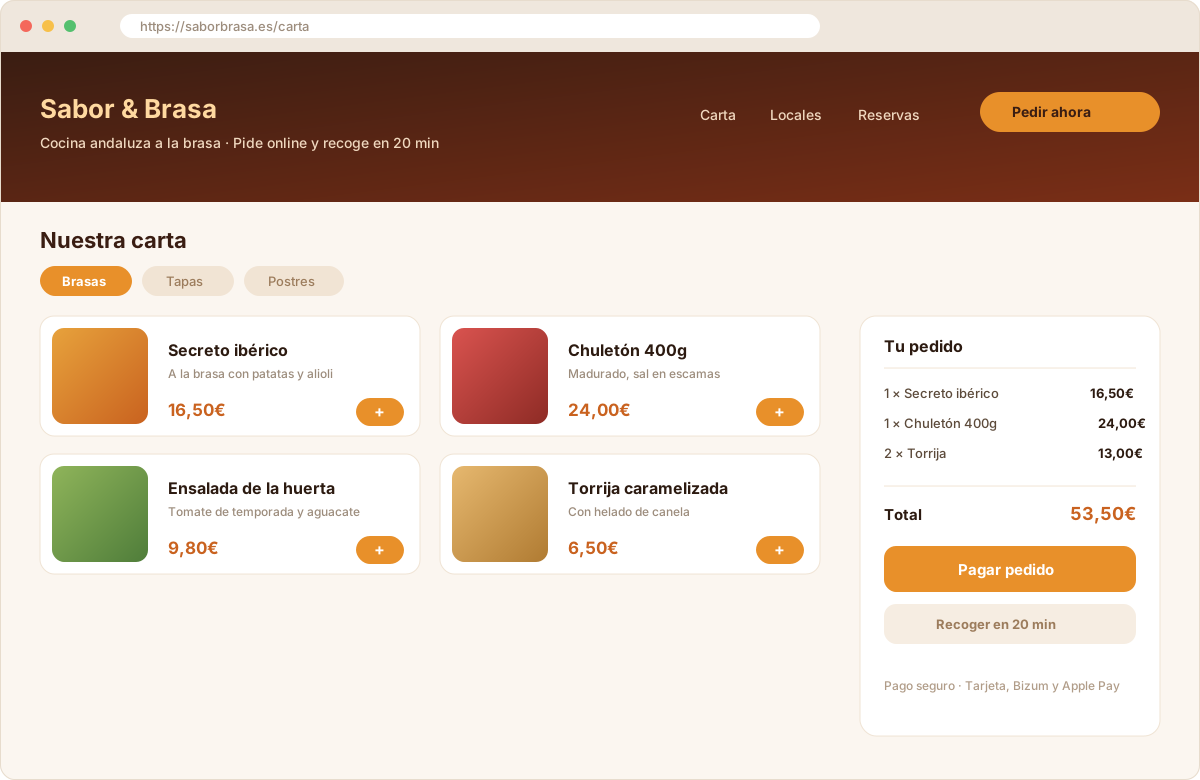
Let me give you a very concrete and very Málaga example. A charcoal-grill restaurant in the area sold well through delivery apps, but when it did the maths the numbers did not add up: a huge part of each order was taken by the app in commissions. They worked flat out at weekends and, at the end of the month, a good chunk of the revenue had evaporated in tolls they did not control.
We built an own ordering website: digital menu, integrated payment gateway, in-store pickup and delivery in their area. The initial investment paid for itself in a few months just with what they stopped paying in commissions. And, besides saving money, they gained something the app never gave them: the database of their regular customers, with which they now launch neighbourhood promotions and announce news on their own.
- Direct orders with no commission per sale, apart from the small cost of the payment gateway.
- Menu and prices under their full control, without the app setting the rules.
- Their own customer data to build loyalty and repeat sales.
- A recognisable brand, not "just another restaurant" lost in the app's listing.
They did not abandon the apps entirely, mind you. They kept them to attract new customers who did not know them yet, but they pushed those customers with discounts towards their own website for future orders. That is the smart play: use the marketplace as the entry door and the own website as the house where they stay. You have more examples like this in my projects.
The 30% rule
If a marketplace takes around a third of each sale, every customer you migrate to your own website is worth three in terms of margin. Moving even part of your recurring customers to your direct channel completely changes the profitability of the business.
Do you want your own online store without endless commissions?
I design custom online stores and ordering websites for businesses in Málaga, built so that the margin stays in your pocket and not in the platforms'.
See web developmentWhen does each model suit you (or combining the two)?
There is no universal answer, but there are fairly clear patterns depending on the type of business. This is the quick guide I share with my clients so they can get their bearings before investing.
It suits you to start with the marketplace if...
- You sell a product people already search for by name (electronics, spare parts, well-known brands).
- You want to quickly validate whether there is demand without investing much upfront.
- Your volume is still low and the commission does not hurt you too much yet.
- You need immediate visibility and do not have time to build your own traffic.
Your own store suits you if...
- You have tight margins and the commission eats into your profitability.
- Your product or service has a brand, a story or a close relationship you want to convey.
- You are looking for a long-term relationship with the customer and recurring purchases.
- You want to own your data and be able to do email marketing and build loyalty.
And for most SMEs the sensible answer is: combine both. Use the marketplace as an acquisition channel and shop window, and your own website as the final destination where the margin and the relationship are concentrated. That said, make your website the strategic priority, not an experiment you leave half-finished. If you have doubts about the investment, I break it down in how much a website costs.
Costs and maintenance of your own online store
Let us be realistic: an own store is not free nor does it "make itself". It has an initial development investment and recurring costs that are worth being clear about from the start so you do not get any nasty surprises. The good news is that, well planned, it works out much cheaper than years of commissions.
- Initial development: design, programming, payment gateway configuration and catalogue integration. It is the big investment, but it is done once.
- Hosting and domain: a moderate annual cost to keep the website online and fast.
- Maintenance: security updates, backups and support. Essential so the store does not become obsolete or vulnerable.
- Marketing: SEO, content and campaigns to attract that own traffic which, over time, saves you the commissions.
Against this, the marketplace has an almost nil entry cost but a very high and permanent variable cost. The own store flips the equation: you pay more at the start and much less on each sale from then on. For a business that aspires to grow and to last, that second equation almost always wins in the medium term.
Maintenance is the part many forget and the one that marks the difference between a store that sells and one that gives problems. A fast, secure and up-to-date website converts better and ranks better. It is not an expense, it is what protects the investment you already made.
Conclusion: renting customers or building an asset
If I had to sum it up in one sentence: the marketplace rents you customers and the own store builds you a business. Neither is bad in itself; what is dangerous is depending only on the marketplace and discovering, too late, that you have worked for years to grow someone else's database while paying commissions that financed their growth, not yours.
My advice for any shop or SME in Málaga is clear: use the marketplace for what it is good at (acquisition and quick validation), but put the focus on building your own channel, where the margin, the brand and the data are yours. The restaurant in the example understood this and today its profitability is not decided by any app. Yours should not be either.
Let's talk about your e-commerce project
Tell me what you sell and where you are now. On a call we will see whether an own store, a marketplace or a combination suits you, and I will give you a clear plan with no commitment.
Book a callFrequently asked questions
In the short term the marketplace has an almost nil entry cost, but its commission per sale (between 8% and 35% depending on the platform) is a permanent cost. The own store requires a larger initial investment, but the cost per sale drops a lot from then on. If you have volume, the own store usually works out more profitable in the medium term.
Let's bring this to your business
If you want to apply what you've read, tell me your case and I'll help you make it happen.
Related articles
Web Development in Málaga: the complete guide to building a website that sells in 2025
Everything you need to know to build a professional website in Málaga: technologies, pricing, performance, SEO and how to choose a developer. A practical guide for companies and freelancers.

The price of a website in Málaga: what it really costs
I explain, without beating around the bush, how much a website costs in Málaga: the factors that move the price, real ranges by type of website and what a good quote should include.
Core Web Vitals and web speed: the practical guide for small businesses
What LCP, INP and CLS are, how to measure your website speed with PageSpeed Insights and which concrete changes improve conversion and SEO ranking.